Blogia
ladymarjorie

Pintura

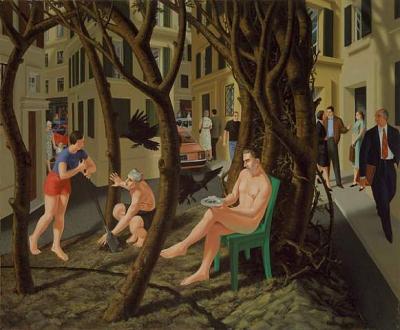
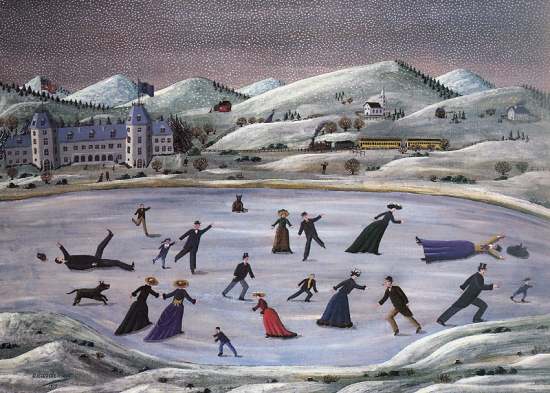
Patinadores de Oscar de Mejo

Patinadores de Oscar de Mejo

Born in Trieste, Italy in 1911, de Mejo had degrees in both Law and Political Science. A believer in the occult and in particular the I Ching, he even chose his art dealer, Ken Nahan according to the I Ching’s advice.

De Mejo’s one constant obsession since boyhood had been painting. After World War II, he married the movie star Alida Valli and they came to the United States. After a stint as a jazz composer, Oscar finally returned to his first love - painting.

Oscar deMejo’s paintings are a mesmerizing mixture of the naive and the sophisticated, the literal and the outlandish. His witty, whimsical depictions of American life are immediately engaging, but upon closer observation their complexity becomes fully apparent, and his unique brand of surrealism is revealed. The myriad irrational and incongruous details that fill his works prod both the concious and unconcious mind.

Oscar de Mejo’s works have been featured in such publications as: American Heritage, Architectural Digest, Art Today, Sciences, Harpers, International Economy, Town and Country, MD Magazine, Vogue Magazine, Die Kunst (Germany), Oggi and Graza (Italy), Yale Literary Magazine, Penthouse, Travel & Leisure and the New York Times.

"The art of Oscar de Mejo is both ’sophisticated’ and ’primitive’. It is ’primitive’ in the sense of being direct, playful, brightly colored and precisely delineated. It is ’sophisticated’ in its choice of themes - and in the degree to which it is artfully influenced by the ’primitive.’ De Mejo has learned things about vision and subtle distortion by studying the work of such naive painters as Bombots and Rousseau, just as Tamayo learned how to disembody his peasants by studying Picasso, or Picasso in turn had gone to school to the African sorcerers - and with as much right."

The Storm Across The Face de Robert Schwartz

The Storm Across The Face de Robert Schwartz

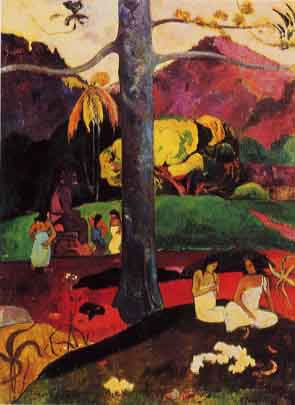
Mata Mua de Gauguin

Mata Mua de Gauguin

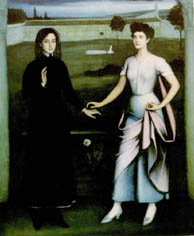
Amor sagrado de Julio Romero de Torres

Amor sagrado de Julio Romero de Torres Julio Romero de Torres (9 de noviembre de 1874 - 10 de mayo de 1930) fue un pintor español. Nació y murió en Córdoba, donde pasó gran parte de su vida. Hijo del también pintor y conocido Rafael Romero Barros, director del Museo Provincial de Bellas Artes de Córdoba, comenzó su aprendizaje a las órdenes de su padre en la Escuela de Bellas Artes de Córdoba a la temprana edad de 10 años. Gracias a su afán por aprender, vivió intensamente la vida cultural cordobesa de finales del siglo XIX y conoció ya desde muy joven todos los movimientos artísticos dominantes de esa época.

Julio Romero de Torres participó con intensidad en todos los acontecimientos artísticos de Córdoba y España. Ya en el año 1895 participó en la Nacional en Madrid, donde recibió una mención honorífica. También participó en las ediciones de 1899 y 1904, donde fue premiado con la tercera medalla. En esta época inició su experiencia docente en la Escuela de Bellas Artes de Córdoba.

En 1906, el Jurado de la Nacional rechazó su cuadro Vividoras del Amor, lo que provocó que el Salón de Rechazados fuera más visitado que las salas de la Exposición Nacional. Ese mismo año marchó a Madrid, para documentarse y satisfacer su inquietud renovadora. Después realizó viajes por toda Italia, Francia, Inglaterra y los Países Bajos.

En 1907 concurrió ya con los pintores más renombrados de la época a la exposición de los llamados independientes en el Círculo de Bellas Artes. Poco después obtuvo por fin su primera medalla en la Nacional del año 1908 con su cuadro Musa gitana. También recibió el primer premio en la Exposición de Barcelona de 1911 con el Retablo de amor, y dos años después en la Internacional de Munich del año 1913. En la Exposición Nacional de 1912, cuando Romero de Torres aspiraba a la medalla de honor, su obra no fue reconocida, lo que provocó que sus admiradores le entregaran una medalla de oro cincelada por el escultor Julio Antonio. Cuando sus cuadros tampoco fueron premiados en la Exposición de 1915 con la medalla de honor decidió retirarse definitivamente de las Exposiciones Nacionales.

En 1916 se convirtió en catedrático de Ropaje en la Escuela de Bellas Artes de Madrid, instalándose definitivamente en la capital. A partir de aquí, su obra comenzó a representar el pabellón español en diversos certámenes internacionales, convocados en París, Londres, etc. Sin embargo, el gran momento de éxito se produjo en Buenos Aires, el año 1922. En agosto de ese mismo año Julio Romero de Torres había viajado a la República Argentina acompañado de su hermano Enrique, y en los últimos días de este mismo mes se inauguró la exposición, que fue presentada en el catálogo por un espléndido texto de Ramón Valle-Inclán. La muestra constituyó un éxito sin precedentes. Fue miembro de la Real Academia de Córdoba y de la de Bellas Artes de San Fernando. También exhibió su obra en la Exposición Iberoamericana de Sevilla en 1929, y en múltiples exposiciones individuales en nuestro país y en el extranjero.

A principios de 1930, Julio Romero de Torres, agotado por el exceso de trabajo y afectado de una dolencia hepática, volvió a su Córdoba natal para tratar de recuperarse. Pintando en su estudio de la Plaza del Potro, realizó entre los meses de enero y febrero la que sería su obra final y más célebremente conocida, La chiquita piconera.

El 10 de mayo de 1930 moría Julio Romero de Torres en su casa de la Plaza del Potro en Córdoba, hecho que conmocionó a toda la ciudad. Las manifestaciones de duelo general que produjo su muerte, en las que participaron en masa desde las clases trabajadoras más humildes hasta la aristocracia cordobesa, dejaron patente la inmensa popularidad de que gozaba el pintor cordobés.

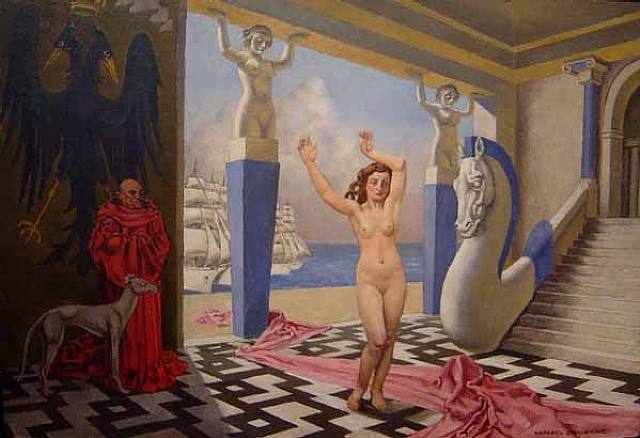
Temple de la Mer, de Raphael Delorme

Temple de la Mer, de Raphael Delorme

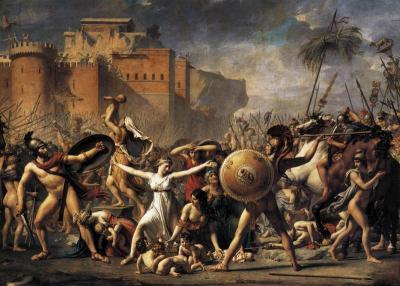
The Sabine Women Enforcing Peace by Running Between the Combatants de Jacques-Louis David

The Sabine Women Enforcing Peace by Running Between the Combatants de Jacques-Louis David

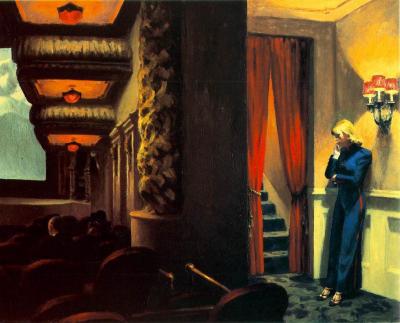
New York Movie de Edward Hopper

New York Movie de Edward Hopper Hopper, Edward (1882-1967). American painter, active mainly in New York.
He trained under Robert Henri, 1900-06, and between 1906 and 1910 made three trips to Europe, though these had little influence on his style. Hopper exhibited at the Armoury Show in 1913, but from then until 1923 he abandoned painting, earning his living by commercial illustration. Thereafter, however, he gained widespread recognition as a central exponent of American Scene painting, expressing the loneliness, vacuity, and stagnation of town life. Yet Hopper remained always an individualist: `I don’t think I ever tried to paint the American scene; I’m trying to paint myself.’
Paintings such as Nighthawks (Art Institute of Chicago, 1942) convey a mood of loneliness and desolation by their emptiness or by the presence of anonymous, non-communicating figures. But of this picture Hopper said: `I didn’t see it as particularly lonely... Unconsciously, probably, I was painting the loneliness of a large city.’ Deliberately so or not, in his still, reserved, and blandly handled paintings Hopper often exerts a powerful psychological impact -- distantly akin to that made by the Metaphysical painter de Chirico; but while de Chirico’s effect was obtained by making the unreal seem real, Hopper’s was rooted in the presentation of the familiar and concrete.
Edward Hopper painted American landscapes and cityscapes with a disturbing truth, expressing the world around him as a chilling, alienating, and often vacuous place. Everybody in a Hopper picture appears terribly alone. Hopper soon gained a widespread reputation as the artist who gave visual form to the loneliness and boredom of life in the big city. This was something new in art, perhaps an expression of the sense of human hopelessness that characterized the Great Depression of the 1930s.

Edward Hopper has something of the lonely gravity peculiar to Thomas Eakins, a courageous fidelity to life as he feels it to be. He also shares Winslow Homer’s power to recall the feel of things. For Hopper, this feel is insistently low-key and ruminative. He shows the modern world unflinchingly; even its gaieties are gently mournful, echoing the disillusionment that swept across the country after the start of the Great Depression in 1929. Cape Cod Evening (1939; 77 x 102 cm (30 1/4 x 40 in)) should be idyllic, and in a way it is. The couple enjoy the evening sunshine outside their home, yet they are a couple only technically and the enjoyment is wholly passive as both are isolated and introspective in their reveries. Their house is closed to intimacy, the door firmly shut and the windows covered. The dog is the only alert creature, but even it turns away from the house. The thick, sinister trees tap on the window panes, but there will be no answer.

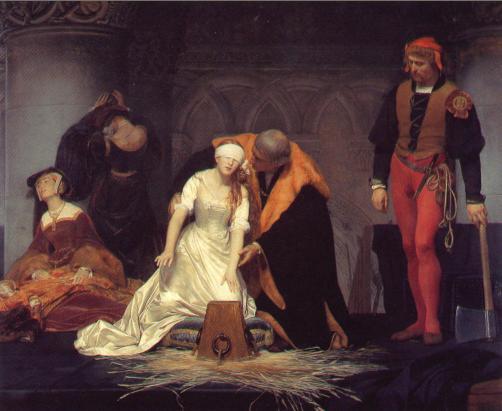
Decapitación de Jane Grey por Delaroche

Decapitación de Jane Grey por Delaroche

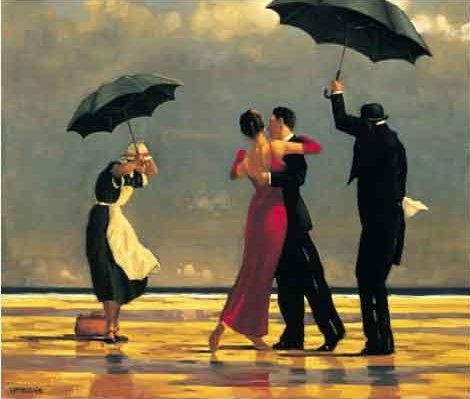
The Singing Butler, de Jack Vettriano

The Singing Butler, de Jack Vettriano Jack Vettriano (born 17 November 1951 Fife) is a Scottish painter. Originally Jack Hoggan, he grew up in the industrial seaside town of Methil, Fife. He left school at 16 and became an apprentice mining engineer, but later took up painting as a hobby in his twenties. His earliest paintings were copies or pastiches of impressionist paintings (his first painting was a copy of Monet’s Poppy Fields).
Vettriano’s breakthrough year was 1988, when he felt ready to display his paintings in public and submitted two canvases for the Royal Scottish Academy annual show. Both paintings sold on the first day and Vettriano was approached by several galleries who wanted to sell his other work. The success and attention contributed to the breakdown of his first marriage and he moved to Edinburgh, changing his name to Vettriano, his mother’s maiden name.

Further successful exhibitions followed in Edinburgh, London, Hong Kong, Johannesburg, and New York. His paintings are reminiscent of the film noir genre, often with romantic or even pornographic themes.

Although his work is generally dismissed by art critics as being vulgar and devoid of imagination, he is one of the most commercially successful living artists. His original paintings now regularly fetch six figure prices, but he is thought to make more money from the sale of reproductions. According to The Guardian, he earns £500,000 a year in print royalties. Each year a new set of limited edition prints are published, and his most popular work, The Singing Butler, sells more posters and postcards than any other painting in the UK. On 21 April 2004 the original canvas of The Singing Butler sold at auction for £744,500 — in stark contrast to 1992 when Vettriano painted the picture and submitted it for inclusion in the Royal Academy summer show, only to be rejected.

In October 2005, it was ’discovered’that figures in some of Vettriano’s paintings, including The Singing Butler, were based on figures from an artists’ reference manual, The Illustrator’s Figure Reference Manual.[1] This revelation did little to tarnish Vettriano’s reputation,however, as he has never denied being self-taught. In his early years he didn’t have the financial resources to hire models. His talent lies in placing his figures in an unusual narrative context.

Vettriano has studios in Scotland and London. He is represented by the Portland Gallery, London and includes Jack Nicholson and Terence Conran amongst his collectors. In 2003 he was awarded the OBE.

[edit] See also

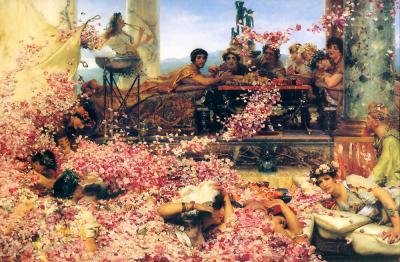
The Roses of Heliogabalus de Alma Tadema

The Roses of Heliogabalus de Alma Tadema

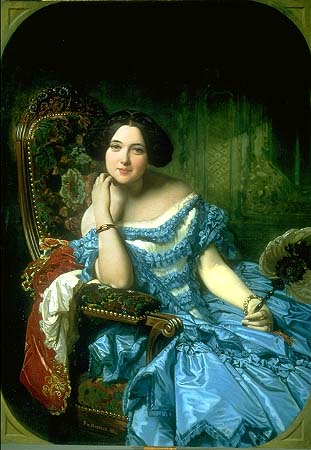
Condesa de Vilches de Federico Madrazo

Condesa de Vilches de Federico Madrazo

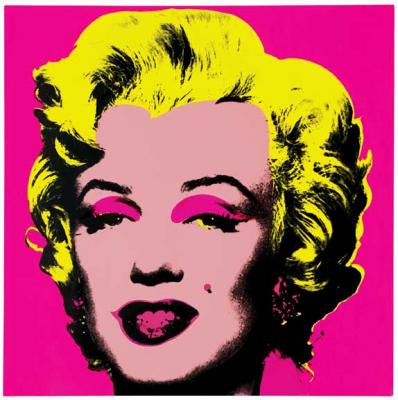
Marilyn, de Andy Warhol

Marilyn, de Andy Warhol

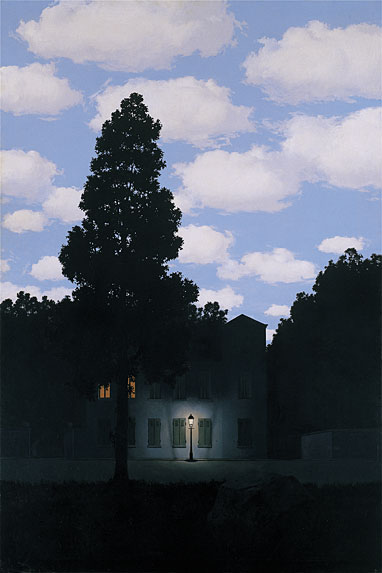
L'empire des lumières de René Magritte

L'empire des lumières de René Magritte